


Introduction
Microservices architecture has revolutionized how modern applications are built and deployed. When combined with AWS’s powerful cloud infrastructure, businesses can create scalable, resilient, and maintainable applications. This guide will walk you through everything you need to know about implementing microservices on AWS.
What is Microservices Architecture?
Microservices architecture is a software development approach where applications are built as a collection of small, independent services. Each service focuses on a specific business function and can be developed, deployed, and scaled independently.
Key Benefits of Microservices
- Scalability: Scale individual services based on demand
- Flexibility: Use different technologies for different services
- Faster deployment: Update services without affecting the entire application
- Better fault isolation: If one service fails, others continue working
Why Choose AWS for Microservices?
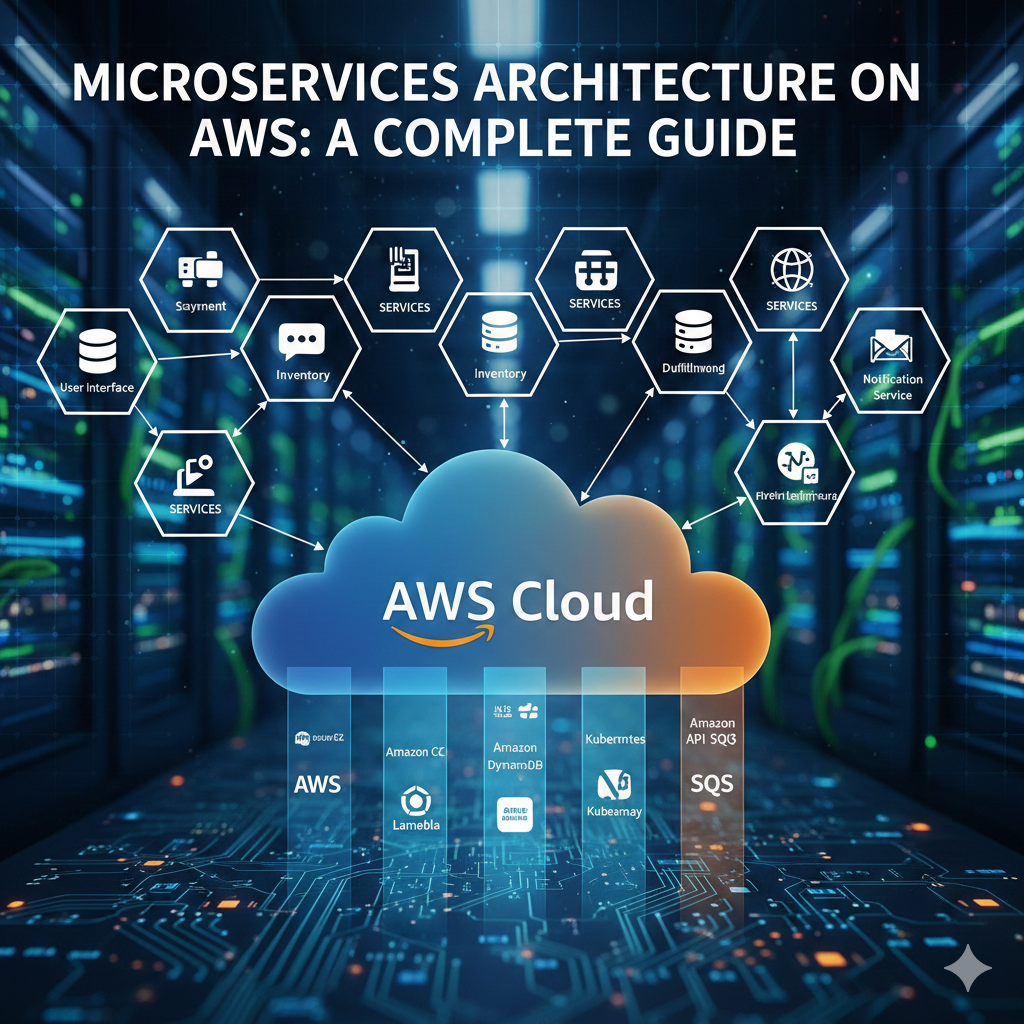
AWS provides a comprehensive suite of tools and services specifically designed for microservices architecture:
Core AWS Services for Microservices
Amazon ECS (Elastic Container Service): Fully managed container orchestration service that makes it easy to deploy and manage containerized applications.
Amazon EKS (Elastic Kubernetes Service): Managed Kubernetes service for running containerized applications at scale.
AWS Lambda: Serverless compute service perfect for building microservices without managing servers.
Amazon API Gateway: Creates, publishes, and manages APIs that act as the front door to your microservices.
Building Microservices on AWS: Step-by-Step
Step 1: Design Your Microservices
Break down your application into smaller, independent services. Each service should have a single responsibility and its own database.
Step 2: Choose Your Compute Platform
Containers with ECS/EKS: Best for applications requiring consistent environments and portability.
Serverless with Lambda: Ideal for event-driven workloads and when you want to avoid infrastructure management.
EC2 Instances: Offers complete control over your environment.
Step 3: Implement Service Communication
Use these AWS services for microservices communication:
- Amazon SQS: Message queuing for asynchronous communication
- Amazon SNS: Publish-subscribe messaging for event notifications
- AWS App Mesh: Service mesh for managing service-to-service communication
Step 4: Set Up API Management
Amazon API Gateway serves as the entry point for your microservices, handling:
- Request routing
- Authentication and authorization
- Rate limiting
- API versioning
Step 5: Implement Data Storage
Each microservice should have its own database to maintain independence:
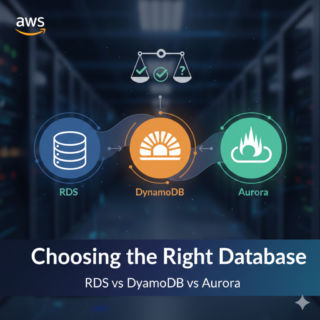
- Amazon RDS: Relational databases
- Amazon DynamoDB: NoSQL for high-performance applications
- Amazon ElastiCache: In-memory caching
Step 6: Enable Monitoring and Logging
Use AWS monitoring tools to track your microservices:
- Amazon CloudWatch: Monitors metrics and logs
- AWS X-Ray: Distributed tracing for debugging
- AWS CloudTrail: Audit and compliance tracking
Best Practices for AWS Microservices
Security
- Implement least privilege access using AWS IAM
- Use AWS Secrets Manager for sensitive data
- Enable encryption at rest and in transit
- Implement VPC for network isolation
Deployment
- Use CI/CD pipelines with AWS CodePipeline
- Implement blue-green deployments
- Use AWS CloudFormation or Terraform for infrastructure as code
Cost Optimization
- Right-size your resources
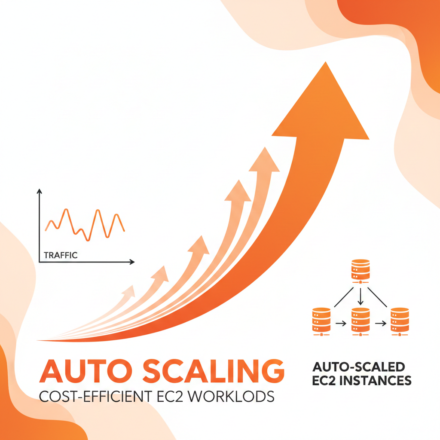
- Use auto-scaling to match demand
- Leverage AWS Cost Explorer for monitoring
- Consider Reserved Instances for predictable workloads
Common Challenges and Solutions
Challenge 1: Service Discovery
Solution: Use AWS Cloud Map or Application Load Balancer for automatic service discovery.
Challenge 2: Data Consistency
Solution: Implement eventual consistency patterns and use AWS services like DynamoDB Streams for data synchronization.
Challenge 3: Monitoring Distributed Systems
Solution: Implement centralized logging with CloudWatch Logs and distributed tracing with X-Ray.
Real-World Example Architecture
A typical e-commerce application on AWS microservices might include:
Notification Service: Sends emails/SMS (Lambda + SNS)
User Service: Manages authentication (Lambda + API Gateway)
Product Service: Handles product catalog (ECS + RDS)
Order Service: Processes orders (ECS + DynamoDB)
Payment Service: Handles transactions (Lambda + SQS)

Leave a Comment