


Introduction
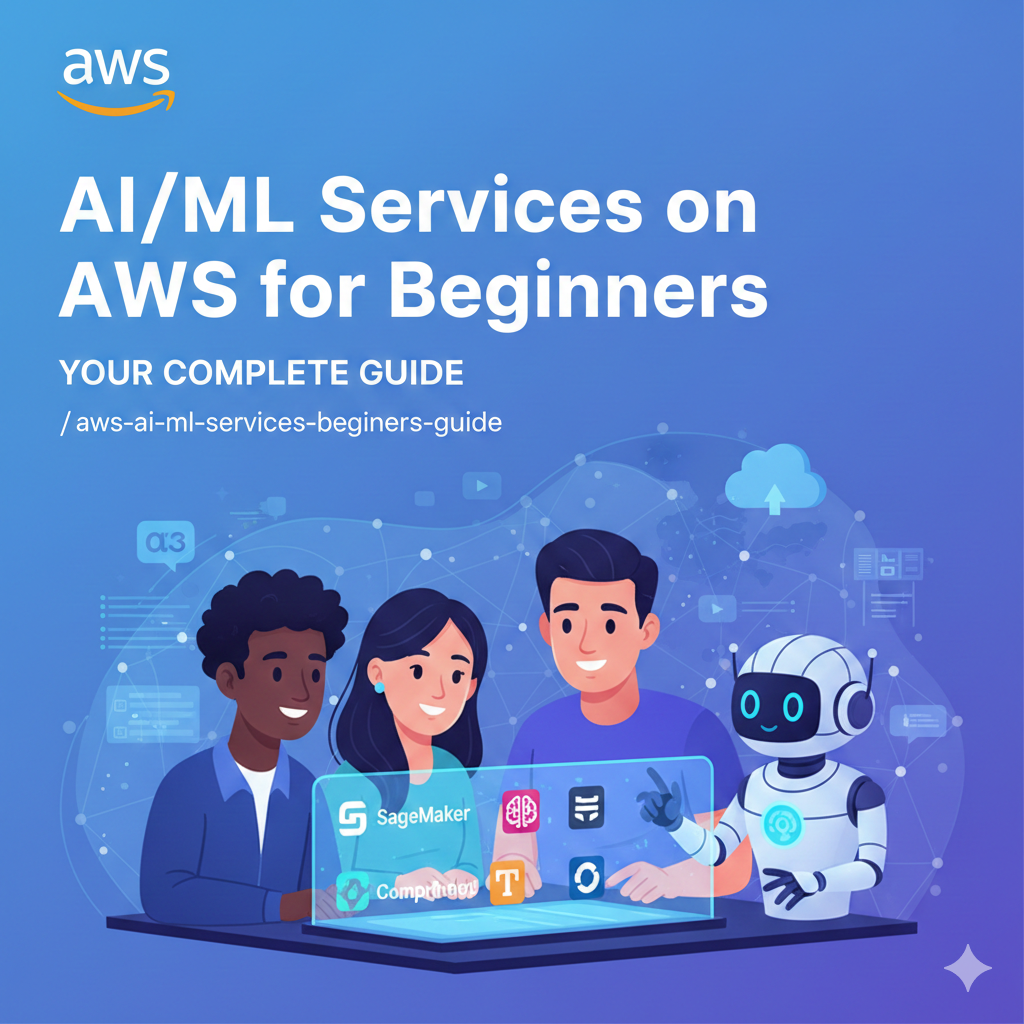
Artificial Intelligence and Machine Learning are transforming businesses across industries. AWS makes these powerful technologies accessible to everyone, regardless of their technical expertise. This beginner-friendly guide will help you understand and start using AWS AI/ML services.
What are AWS AI/ML Services?
AWS AI/ML services are pre-built, fully managed tools that let you add intelligent features to your applications without needing deep machine learning expertise. You can build applications that see, hear, speak, understand, and interact with the world.
Why Use AWS for AI/ML?
Key Advantages
- No ML expertise required: Use pre-trained models
- Pay-as-you-go pricing: Only pay for what you use
- Scalable: Handle any workload size
- Fast deployment: Get started in minutes
AWS AI Services: Understanding the Basics
AWS AI services are organized into three layers:
1. AI Services (No ML Knowledge Required)
Pre-built APIs you can use immediately with simple API calls.
2. ML Services (Some Technical Knowledge)
Tools for building and training your own models.
3. ML Frameworks (Advanced Users)
Infrastructure for custom deep learning projects.
Top AWS AI Services for Beginners
Amazon Rekognition: Computer Vision Made Easy
What it does: Analyzes images and videos to detect objects, people, text, scenes, and activities.
Use cases:
- Face detection and recognition
- Content moderation
- Celebrity recognition
- Text detection in images
Getting started: Upload an image and call the API to detect faces, objects, or text. No training required.
Amazon Polly: Text-to-Speech
What it does: Converts text into lifelike speech in multiple languages and voices.
Use cases:
- Voice-enabled applications
- E-learning platforms
- Accessibility features
- Audio content creation
Getting started: Send text to Amazon Polly and receive audio files back. Choose from dozens of natural-sounding voices.
Amazon Transcribe: Speech-to-Text
What it does: Automatically converts speech into accurate text transcriptions.
Use cases:
- Meeting transcriptions
- Subtitle generation
- Customer service analysis
- Voice command applications
Getting started: Upload audio files and receive text transcriptions with timestamps and speaker identification.
Amazon Comprehend: Natural Language Processing
What it does: Discovers insights and relationships in text through sentiment analysis, entity recognition, and topic modeling.
Use cases:
- Customer feedback analysis
- Document classification
- Social media monitoring
- Content recommendation
Getting started: Send text data and get insights about sentiment, key phrases, entities, and language.
Amazon Translate: Language Translation
What it does: Provides fast, high-quality language translation for 75+ languages.
Use cases:
- Website localization
- Multi-language customer support
- Document translation
- Real-time chat translation
Getting started: Send text in one language and receive accurate translations in another.
Amazon Lex: Build Conversational Interfaces
What it does: Creates chatbots and voice assistants using the same technology as Alexa.
Use cases:
- Customer service chatbots
- Virtual assistants
- Information retrieval bots
- Automated booking systems
Getting started: Design conversation flows visually and deploy to websites, mobile apps, or messaging platforms.
AWS ML Services for Building Custom Models
Amazon SageMaker: Complete ML Platform
What it does: Provides everything needed to build, train, and deploy custom machine learning models.
Key features:
- SageMaker Studio: Integrated development environment
- SageMaker Autopilot: Automatically builds ML models
- Built-in algorithms: Pre-configured ML algorithms
- Model deployment: One-click deployment to production
When to use: When pre-built AI services don’t meet your specific needs and you want to create custom models.
Amazon Forecast: Time-Series Predictions
What it does: Uses machine learning to create accurate forecasts based on historical data.
Use cases:
- Sales forecasting
- Demand planning
- Resource allocation
- Financial predictions
Amazon Personalize: Recommendation Systems
What it does: Creates personalized recommendations for users based on their behavior.
Use cases:
- Product recommendations
- Content recommendations
- Marketing personalization
- Search result ranking
Getting Started: Your First AI Project
Step 1: Choose Your Service
Identify what you want to achieve:
- Analyzing images? Use Amazon Rekognition
- Converting text to speech? Use Amazon Polly
- Understanding text sentiment? Use Amazon Comprehend
Step 2: Set Up Your AWS Account
- Create a free AWS account
- Navigate to the AWS Management Console
- Search for your chosen AI service
Step 3: Try the Demo
Most AWS AI services offer demos where you can test functionality:
- Upload sample data
- See results instantly
- Understand the output format
Step 4: Integrate with Your Application
Use AWS SDKs available in multiple programming languages:
- Python (Boto3)
- JavaScript
- Java
- .NET
- PHP
Step 5: Monitor and Optimize
Use AWS CloudWatch to track:
- API usage
- Costs
- Performance metrics
- Error rates
Practical Examples for Beginners
Example 1: Image Analysis Application
Create an application that automatically tags uploaded photos:
- User uploads a photo to Amazon S3
- Trigger Lambda function
- Call Amazon Rekognition to detect objects
- Store tags in database
- Display results to user
Example 2: Customer Feedback Analysis
Analyze customer reviews automatically:
- Collect customer reviews
- Send reviews to Amazon Comprehend
- Extract sentiment (positive, negative, neutral)
- Identify key topics and entities
- Generate insights dashboard
Example 3: Multi-Language Support
Add language translation to your website:
- User selects their preferred language
- Application sends content to Amazon Translate
- Receive translated content
- Display in user’s language
- Cache translations for faster loading
Cost Management for Beginners
Free Tier Benefits
AWS offers generous free tiers for AI services:
- Amazon Rekognition: 5,000 images/month for 12 months
- Amazon Polly: 5 million characters/month for 12 months
- Amazon Comprehend: 50,000 units/month for 12 months
Cost Optimization Tips
- Start with free tier services
- Use batch processing for non-time-sensitive tasks
- Monitor usage with AWS Cost Explorer
- Set up billing alerts
- Cache frequently used results
Best Practices for Beginners
Data Privacy
- Review AWS data privacy policies
- Understand data retention periods
- Use encryption for sensitive data
- Comply with regulations (GDPR, HIPAA)
Testing and Validation
- Test with sample data first
- Validate accuracy for your use case
- Consider human review for critical applications
- Monitor model performance over time
Integration
- Use AWS SDKs for easier integration
- Implement error handling
- Add retry logic for failed requests
- Monitor API limits and quotas
Common Beginner Mistakes to Avoid
- Not using the free tier: Take advantage of free usage limits
- Ignoring documentation: AWS provides excellent guides and tutorials
- Over-engineering: Start simple and add complexity as needed
- Forgetting monitoring: Set up CloudWatch from the beginning
- Not testing thoroughly: Validate results with your specific data
Learning Resources
AWS Official Resources
- AWS Free Training: Free online courses on AI/ML
- AWS Documentation: Comprehensive guides for each service
- AWS Workshops: Hands-on learning experiences
- AWS YouTube Channel: Video tutorials and demos
Getting Help
- AWS Support: Technical support plans available
- AWS Forums: Community support
- Stack Overflow: Developer community
- AWS re:Post: Q&A service
Next Steps After Getting Started
Once comfortable with basic AI services:
- Explore Amazon SageMaker for custom models
- Combine multiple AI services for complex solutions
- Learn about MLOps and model deployment best practices
- Consider AWS certification in Machine Learning
Conclusion
Both microservices architecture and AI/ML services on AWS offer powerful capabilities for modern applications. Microservices provide the flexibility and scalability needed for complex applications, while AWS AI/ML services make advanced technologies accessible to developers at all skill levels.
Start with the basics, experiment with free tier services, and gradually build more sophisticated solutions. AWS provides the tools, documentation, and support needed to succeed in both areas. Whether you’re building a scalable microservices application or adding intelligent features with AI/ML, AWS has the services to bring your ideas to life.
Remember: the best way to learn is by doing. Start with a small project, use AWS free tier resources, and gradually expand your knowledge and capabilities.






Leave a Comment