

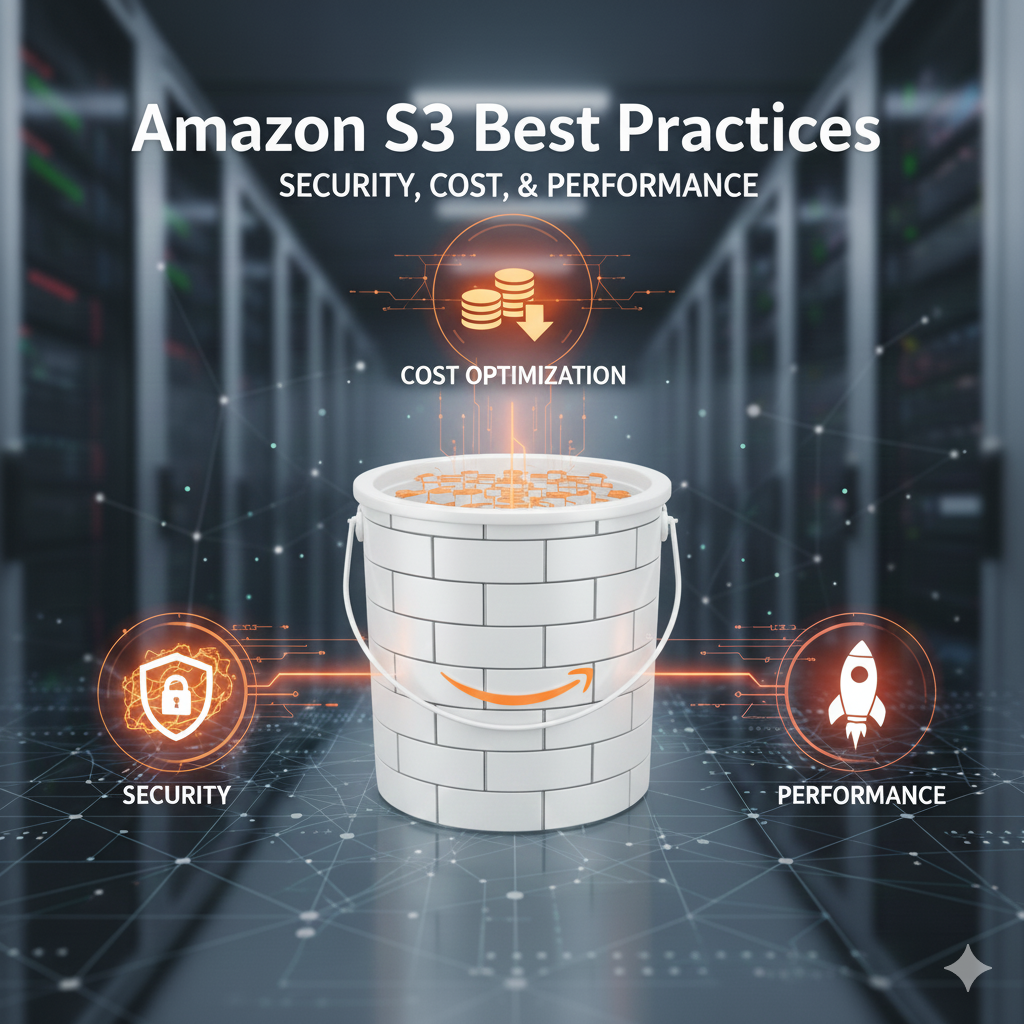

Amazon Simple Storage Service (S3) is a core component of cloud storage systems that works well with compute resources like Amazon EC2, is almost infinitely scalable, and is very resilient. Originally intended to be safe and robust, S3’s success mostly depends on how it is configured and managed. Poor configuration might lead to useless costs, performance bottlenecks, and security weaknesses.
This sub-blog provides best recommendations for safeguarding Amazon S3, managing storage costs, and maximizing performance in business cloud environments.
Security Best Practices for Amazon S3
Security is the most critical aspect of S3 usage, as misconfigured buckets are a common source of data exposure.
Enforce Least-Privilege Access
Access to S3 should always follow the principle of least privilege. Use AWS Identity and Access Management (IAM) policies to grant only the permissions required for specific users, applications, or EC2 instances. Avoid using wildcard permissions and prefer role-based access for services running on EC2.
Encrypt Data at Rest and in Transit
Enable server-side encryption using AWS-managed or customer-managed keys to protect data at rest. Enforce HTTPS connections to ensure data is encrypted in transit. Encryption is especially important when S3 is used as a backend storage layer for EC2-hosted applications.
Enable Logging and Monitoring
Activate S3 server access logging and integrate logs with monitoring tools to track access patterns and detect unauthorized activity. Regular audits help ensure compliance with internal and regulatory security requirements.
Cost Optimization Best Practices
While S3 is cost-effective at scale, unmanaged usage can lead to unnecessary expenses over time.
Use Appropriate Storage Classes
Select storage classes based on data access frequency. Frequently accessed data should remain in standard storage, while infrequently accessed or archival data should be transitioned to lower-cost tiers. Lifecycle policies automate this process and prevent long-term cost accumulation.
Implement Lifecycle Policies
Lifecycle rules can automatically move data to cheaper storage classes or delete obsolete objects. This is particularly valuable for logs, backups, and temporary data generated by EC2 workloads.
Minimize Data Transfer Costs
Data transfer between S3 and EC2 within the same region is typically cost-efficient, but cross-region transfers can become expensive. Designing architectures that keep compute and storage in the same region reduces both latency and cost.
Monitor and Tag Storage Usage
Consistent tagging enables cost allocation and accountability across teams and projects. Regular usage reviews help identify unused buckets, redundant objects, or oversized datasets.
Performance Optimization Best Practices
S3 is designed for high availability and scalability, but performance optimization requires architectural awareness.
Optimize Object Access Patterns
Distribute object requests evenly across prefixes to maximize throughput. Avoid access patterns that concentrate heavy read or write activity on a small set of objects.
Use Multipart Uploads
Multipart uploads improve reliability and performance for large objects by uploading parts in parallel. This is especially beneficial for EC2-based applications handling large datasets or backups.
Integrate Caching and Content Delivery
For frequently accessed objects, integrate caching mechanisms or content delivery networks to reduce latency and offload repeated requests from S3. This improves application responsiveness while reducing compute and storage overhead.
Choose the Right Region
Placing S3 buckets in the same region as EC2 instances minimizes network latency and enhances overall application performance. Regional alignment is critical for data-intensive workloads.
S3 and Its Role in Large-Scale Compute Architectures
In business systems, Amazon S3 is a central, long-term data layer that interacts with flexible computing platforms like EC2. Applications can remain stateless by storing assets, logs, backups, and datasets in S3. This allows EC2 instances to scale dynamically without any loss of data.
S3 is an important service in current cloud settings because it also supports analytics pipelines, machine learning activities, and backup strategies. When used with excellent security controls, cost management, and performance optimization, S3 helps companies grow safely while maintaining operational efficiency.
Conclusion
More than simply a storage solution, Amazon S3 is a fundamental building block for flexible cloud systems. Using best security, cost control, and performance approaches ensures that S3 operates corporate operations continuously and successfully. When correctly paired with compute services such Amazon EC2, S3 enables resilient, high-performance systems that meet commercial as well as technical objectives.





Leave a Comment